Last updated June 2, 2026
May 19 · Continued
The developer disowned the trails they drew. ConCom returns June 16 to take the Order of Conditions back up.
See What Happened
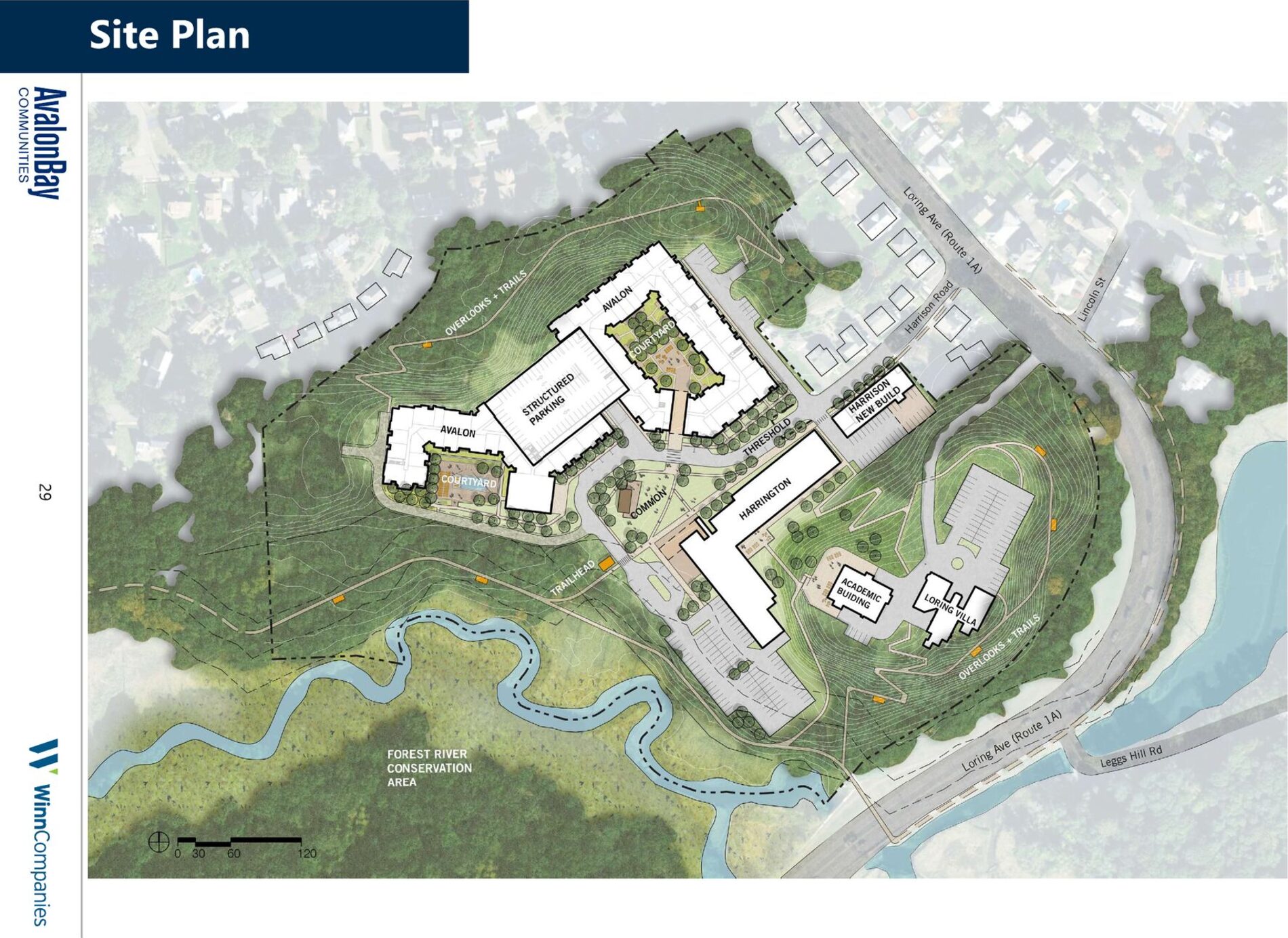
To win the public bid for the Salem State South Campus, the developer promised accessible trails and overlooks through the Forest River woods, and mapped them on the plan below. At the May 19 hearing, they called those same trails “not feasible.”
Dear Salem ConCom Agent,
I am writing as a Salem resident
about DEP File #064-0825…
+ your name here
Let ’em know.
Already written. Just add you.
The university campus is being replaced by up to 485 private apartments across two phases. On April 23, the Planning Board approved Avalon’s Phase I (340 units); Winn’s Phase II was continued. On May 19 the Conservation Commission hearing was continued after the developer disowned the trail network in its own proposal. On June 16 the Commission takes the Order of Conditions back up — the venue that can require the developer to build the accessible trails, overlooks, and public access it proposed.
Dear Salem ConCom Agent,
I am writing as a Salem resident
about DEP File #064-0825…
+ your name here
Let ’em know.
Already written. Just add you.
⚠ Remember to add your Name & Address to the email!
§1.4 · The developer’s own RFP, in their own words
These are pages from the proposal AvalonBay and WinnDevelopment filed to win this public land in 2022. Read what they committed to. Then read what actually happened.
From the executive summary of their winning bid · RFP p. 6
“The Development Team will enhance connectivity to the scenic Forest River Conservation Area Trailhead, through establishing new landscape areas and walking trails for the residents of the community and public to enjoy.”
The commitment to win the land was plural. Trails, not a trail. A network through the woods, for the residents and the public. The developer’s own words. The same plural commitment now described as “not feasible.”
RFP response · p. 44 · “Forest River Conservation Area Access”
“The area within and immediately adjacent will be upgraded by the project to promote best practices and trail resiliency in concert with the Conservation Commission.”
A written commitment, on a binding public bid, to design the trail work with the Conservation Commission. Not to inform them after the fact. Not to ask later if convenient. In concert with.
RFP response · p. 55 · “Zoning and Environmental Permits”
“The first action will be to engage with the neighborhood via a series of community meetings in order to understand their desires and opportunities to enhance the development plan… the development team will seek site plan approval from the Planning Board and an Order of Conditions from the Conservation Commission.”
A written commitment to talk with the neighborhood first, and to seek an enforceable Order of Conditions from the Conservation Commission as part of the project’s ordinary permitting path.
Third promise · on camera, to the neighborhood
“We need to… make sure that we have spots where folks that come to visit, you know, have ample parking and we’ll make sure we get that involved in one of our site plans.”
Dave Gillespie, AvalonBay, responding to a resident asking how the public would reach the Forest River trails. Aug 12, 2024 (timestamp 46:08).
And later in the same meeting, responding to Steve Dibble — a 35-year volunteer who helped build the existing FRCA trail network and a former Salem Conservation Administrator — asking for a permanent deeded public-access easement with parking:
“On the permanent access to the Forest River Conservation Area with parking, we’ve heard that loud and clear. We’re going to study it and get back to the community with a proposal.”
Same meeting, timestamp 68:48. Two years later, no proposal has come back to the community.
Now, what actually happened
Reality vs. p. 44 · May 19, 2026 ConCom hearing
WinnDevelopment’s representative told the Conservation Commission that the accessible footpaths and overlooks drawn on the winning Site Plan cannot be built. A commissioner described it on the record as a bait-and-switch. The terrain has not changed since the developer first drew those trails in 2022. The same plan view with the same trail network was presented to the public at the August 12, 2024 community meeting — and again at the December 9, 2024 meeting at the Harrington Building with Mayor Pangallo, when the developer needed City approval of the 40R development. That was just 17 months before the same developer told the Conservation Commission those same trails are “not feasible.” What changed is that the land has now been awarded.
And the public file does not show any pre-filing coordination of the trail or wetland-buffer design with the Commission. The promise was to design with the Conservation Commission. The reality was to present to the Commission, once, and to disown the trail network on the same day.
Source: Salem Conservation Commission hearing, May 19, 2026 (DEP File #064-0825). Salem ConCom NOI public record.
Reality vs. p. 55 + on-camera promises
The developer did hold the promised meetings. Residents raised specific, concrete concerns. Two years later, on April 23, 2026, the Planning Board approved Phase I of the project with no conditions imposed in response to the public record. The RFP promised meetings “to enhance the development plan.” The plan was not enhanced.
Source: Salem Planning Board approval, April 23, 2026. Public comment record on file with the City Clerk. All resident quotes below are verbatim from the Aug 12, 2024 community meeting (YouTube, timestamps in brackets).
Voice from the room · Aug 12, 2024 [64:15]
“This property is zoned single family… to give back to the developers something substantial, the developers should be giving something very big and very substantial back to Salem to protect our neighborhood.”
Steve Dibble. Former senior city planner. Former Conservation Administrator. Former Salem city councilor. Helped build the 220-ft Volunteers Bridge with neighbors over 35 years. Speaking at the August 12, 2024 community meeting on the South Campus redevelopment.
A point of language · from the developer’s own RFP
The developer’s own RFP and the DCAMM Selection Memo both describe the “enhanced connectivity” commitment as two distinct deliverables, joined by the word AND. Not or. Not either. Both.
RFP, executive summary · p. 6
“The Development Team will enhance connectivity to the scenic Forest River Conservation Area Trailhead, through establishing new landscape areas AND walking trails for the residents of the community and public to enjoy.”
DCAMM Selection Memo · p. 8, “Connectivity”
“The development team will enhance connectivity to the scenic Forest River Conservation Area Trailhead, through establishing new landscape areas AND walking trails AND exploring multi modal connections to and from the site for residential and public use.”
The Selection Memo describes the landscaped Common as “the heart of the Forest River Residences… a center for the new community” — a residential amenity. The walking trails and overlooks were described separately, as a public-access deliverable for “people from all over the city.”
In the developer’s own words · Aug 12, 2024 [20:28]
Dave Gillespie: “That includes half acre, 20,000 square foot common space at the center, which is the gateway to the Forest River Conservation Area…”
A gateway is the entry point to something else, by definition. Gillespie’s own framing places the Common as the doorway. What lies beyond it is the existing Forest River Conservation Area trail network — the trails that volunteers built over decades, the 200-ft bridge that has been there since 1997. That access already exists.
Connectivity to the conservation area was not a throwaway extra. The DCAMM Selection Memo dedicated a full “Connectivity” comparison section to it, evaluating how each of the three competing proposals would deliver on the public-access commitment. It was a stated, evaluated public benefit that informed how Avalon and Winn won this land.
What the developer promised DCAMM was bigger than a gateway. The RFP and the Selection Memo both committed to “multi modal connections to and from the site for residential and public use.” The proposal specifically named a new path connection from Loring Avenue, at the existing crosswalk across from the Legg’s Hill Road bridge over the Forest River, sited along a former driveway alignment “parallel to the river on the site’s southernmost edge” — a riverbank walk leading from the Loring Avenue crosswalk past the river’s upstream beauty into the existing trailhead. The RFP itself described “welcoming people to use the conservation and landscape areas” with signage at the entry. A showpiece arrival, not a parking-lot scramble.
What is being delivered is the opposite of that. The Loring path stays — but it ends in a busy parking lot. There is no designated pedestrian path for visitors to navigate across. Visitors arriving from Legg’s Hill, the YMCA, or the wider Salem street network are dumped into vehicle traffic with no safe route across to the trailhead. That is not multi-modal connectivity. That is not the public-benefit commitment that won this public land. It is a disgrace to the people of the area, and it does not harbor a welcoming feeling.
The pattern is clear. The new trail network on the developer’s own parcel: not feasible. The riverbank path the proposal showcased: not feasible. A safe, signed pedestrian route across the development: not feasible. The Common — which doubles as residential amenity for the new units — remains feasible. The developer’s bottom line is the bottom line. Anything that costs them more money has become “not feasible.”
Sources: AvalonBay + WinnCompanies RFP response p. 6 and pp. 44, 55; DCAMM Selection Memo (Salem State University South Campus Disposition Evaluation Committee), September 15, 2022, p. 8; AvalonBay community meeting recording, August 12, 2024 (YouTube wN-N7xiluPA, 20:28).
Receipts
Every resident concern below is taken verbatim from the Aug 12, 2024 community meeting. Every “reality” is verifiable in the public planning record.
What was said
What was promised
What happened
Developer’s framing · [17:38]
Dave Gillespie: “The Forest River Conservation Area, when we first visited this site, looked like an underutilized natural resource that the city of Salem could really use.”
Developer’s commitment · same moment
Gillespie: “One of the things that we focused on is how do we improve access to that and make a front door to that. So people from all over the city can come and say, ‘Hey, we have this great walking trail in the woods.’”
Reality · May 19, 2026
The same developer told the Conservation Commission the trails meant to be that “front door for the whole city” are “not feasible” to build. The framing that won the land has been disowned.
Resident concern · [34:34]
“One of the things that was discussed [in the Sasaki study] was a second point of egress or access. I don’t see that here.”
Holly Wolpert, 7 Cedar Street.
Developer response · [34:50]
“Any other access you can get out to Loring is environmentally sensitive… we really can’t do it feasibly. So Harrison Road is going to be our main point of entry and egress.”
Reality · 2026
Still one egress for up to 485 apartments. A real second egress would require disturbing the conservation buffer, which would trigger the full MEPA review the project has worked hard to avoid.
Resident concern · [28:25]
“Will you be required to file with the Department of Environmental Protection?… Have you identified the thresholds, and have you looked at the thresholds?”
Developer response · [28:50]
“Based on the project as it exists today, we don’t think we’re MEPA required to do MEPA.”
Reality · 2024-2026
Project impacts grew roughly 2.7× between filings. The state declined to reopen the threshold review under the “sufficiently related” doctrine. The full second-tier environmental review residents asked about never happened.
Resident concern · [28:57]
“Where would you put your detention ponds, your retention ponds? How do you anticipate flow from the site going off site? Have you done any civil design?”
Developer response · [29:31]
“We’ve done some very preliminary conceptual work so that the image we show you today we think works.”
Reality · April 2026
The City’s NECE peer review (April 10, 2026) found 9 of 10 stormwater standards UNRESOLVED. The Conservation Commission is the sole substantive stormwater reviewer; MassDEP issued no comments.
Resident concern · [45:56]
“I love that there’s going to be better access to the conservation area, but is there a place for me parking? How would everybody else in the city access it?”
Developer response · [46:08]
Dave Gillespie: “Make sure that we have spots where folks that come to visit, you know, have ample parking and we’ll make sure we get that involved in one of our site plans.”
Reality · April 23, 2026
The site plans show four parking spaces plus one ADA space at the trailhead. But the public has seen no recorded easement, no binding condition, no disposition-agreement language making any of it enforceable. A slide is not a promise.
Resident concern · [64:53]
“The Forest River Conservation Area trail needs to have permanent public access with parking… either deeded or permanent record easement… the trail that I spent 35 years building the bridges and the walkways with…”
Steve Dibble. Former senior city planner, former Conservation Administrator, former Salem city councilor. Helped build the 220-ft Volunteers Bridge with neighbors over 35 years.
Developer response · [68:48]
Dave Gillespie, in direct response to Steve Dibble: “On the permanent access to the Forest River Conservation Area with parking, we’ve heard that loud and clear. We’re going to study it and get back to the community with a proposal.”
Reality · two years later
No proposal has come back to the community. The site plans gesture at a handful of trailhead spaces, but the public has been shown no deed language, no recorded easement, and no binding condition that would make permanent access enforceable. Under M.G.L. c. 7C § 34, public-benefit commitments bind only when set forth in the deed, disposition agreement, or Order of Conditions. None of that exists in the public file.
All resident quotes verbatim from the public YouTube recording of the Aug 12, 2024 community meeting (video ID wN-N7xiluPA), with timestamps. Full transcript on file.
The developer’s own RFP set the standard. A binding Order of Conditions on June 16 is the one venue that can hold them to it.
Sources: AvalonBay + WinnCompanies, “Salem State University South Campus” RFP response (2022), pp. 44 and 55. Filed with the Massachusetts Division of Capital Asset Management and Maintenance (DCAMM). Public document.
First, to be clear
Salem needs homes, and this project delivers real ones. WinnDevelopment — the nation’s largest manager of affordable housing — is committing to roughly 60% affordability across the 55+ community in the historic Loring Villa and Convent buildings, and the broader project reserves roughly half its units for households at or below 80% of area median income. That is genuinely needed housing, and it deserves to get built.
This is not a fight against the housing. It is a request that the developer keep one promise they made to win this public land: build the trails they drew. The homes and the trails were always meant to come together — that was the deal.
Source: AvalonBay + WinnDevelopment RFP response (affordability commitments).
— What’s actually here —
The Forest River Conservation Area carries two independent legal locks — one from Massachusetts, one from the federal government — plus a Certified Vernal Pool with a state-listed obligate species. Every fact below is verified to a primary public record.
Land Acknowledgement
This land is Naumkeag — the traditional and ancestral homeland of the Pawtucket band of the Massachusett people. Salem records a 1686 quitclaim deed from the heirs of sachem Wenepoykin to the Town Selectmen for £20; the original parchment is held in the Salem City Clerk’s vault. The Forest River appears in 1624 records as Massabequash, a Naumkeag place.
Source: Salem Historical Profile (salemma.gov/city-clerk/pages/historical-profile); Salem State Land Acknowledgement (salemstate.edu/LandAcknowledgement).
Massachusetts · State Lock
All 97.73 acres of the Forest River Conservation Area are coded ARTICLE97 = 1, LEV_PROT = P (Perpetuity) in MassGIS. Article 97 of the Massachusetts Constitution requires a two-thirds vote of both chambers of the state Legislature to convert any of it to non-conservation use.
MassGIS Protected & Recreational OpenSpace; Salem 2023–2030 Open Space & Recreation Plan (state-approved 2024-01-08).
United States · Federal Lock
90 of the 97.73 acres were acquired with federal Land & Water Conservation Fund grant money. Under 54 U.S.C. § 200305(f)(3), any conversion of LWCF-encumbered land requires National Park Service approval and replacement land of equal value. This protection runs independent of, and in addition to, Article 97.
MassGIS attribute fields GRANTPROG1=SH (State Self-Help) + GRANTPROG2=LWCF, EOEAINVOLVE=1. The 1997 LWCF attachment is referenced on the existing Salem State entry sign.
Natural Heritage · State-Certified
Inside the largest FRCA polygon, the Massachusetts Natural Heritage & Endangered Species Program certified a vernal pool on June 11, 2003, on the basis of an obligate species: fairy shrimp. Certified pools are protected under the Wetlands Protection Act, with regulated buffers extending around their perimeter.
MassGIS NHESP Certified Vernal Pools, CVP #3192. Coordinates: 42.491846° N, 70.904555° W.
BioMap · Coastal Resilience
The MassGIS DEP Wetlands layer documents 38 wetland polygons in the FRCA — including salt marsh, tidal flats, wooded swamp, and a 112.83-acre tidal-flat polygon along the Forest River channel. Both the FRCA and South Campus edges fall inside BioMap Critical Natural Landscape “Coastal Adaptation Areas” — salt marsh and adjacent upland buffer flagged for climate resilience.
MassGIS DEP Wetlands (1:12,000); BioMap Critical Natural Landscape Components (Coastal Adaptation sublayer).
A documented contamination history · why disturbance matters
From 1840 through 1968, a lead-paint manufacturer operated on the Marblehead bank of the Forest River, directly across from what is now the FRCA. A 2015 Geological Society of America study of marsh-peat cores in the Forest River estuary documented elevated lead and arsenic concentrations in the upper ~28 cm of sediment — the depth a new footing or stormwater outfall would penetrate. Any project disturbing the marsh sediment must contend with this historical industrial signature.
Source: Geological Society of America 2015 abstract, “Salt Marsh Stratigraphy and Environmental History: Forest River Estuary, Salem, MA.” Operating dates from Salem Public Library wiki, Forest River Lead Works.
The city has already studied this
In February 2016, the Salem Conservation Commission and the Community Preservation Committee jointly funded a Forest River Conservation Area Trails Assessment by Kyle Zick Landscape Architecture and Childs Engineering Corporation. The report identified priority improvements — signage, an accessible crushed-stone path, erosion control, boardwalk replacement — and recommended specific scopes and 2016-dollar costs for each. A 2017 state Recreational Trails grant of approximately $66,400 covered roughly 10% of the recommended scope. The remainder has gone unfunded for a decade.
Public document: salemma.gov/DocumentCenter/View/2418 · Forest River Conservation Area Trails Assessment, Feb 2016.
— How we got here —
The promise of public access through these woods runs back nearly 30 years. The developer offered to extend it, in writing and on their own plans, to win the bid. Watch that commitment shrink in three documented beats — ending with the moment they called the trails they drew “not feasible.”
Ward 7 Councilor Steve Dibble and more than 100 residents built a 200-foot, 6-foot-wide boardwalk across the Forest River salt marsh over two weekends. It was named the Volunteer Bridge.
The City used an $87,500 state recreational trails grant to build a stone-dust, wheelchair-accessible trail from the Salem State South Campus parking lot trailhead to the Volunteer Bridge. Designed by Kyle Zick Landscape Architecture, it was the first public investment in the conservation area in more than 30 years. Then-Assistant Planner Tom Devine described it: “just about anyone, regardless of their ability, is able to traverse the main trunk trail.”
That accessible trunk trail was meant to be the start, not the end. Several miles of conservation-area trails extend through the woods to the west and south — the same routes the developer would later promise, in writing, to upgrade and connect. The public investment was already on the ground when they made that promise.
Sources: Salem News · Kyle Zick Landscape Architecture
DCAMM opens bidding on the 23-acre South Campus. At the announcement, Mayor Driscoll names three public goods the sale should deliver: housing, “improve access to and preservation of sensitive conservation areas,” and protect the historic Saint Chretienne convent.
Contemporary news coverage describes the site in its own voice as supporting “an entrance to the Forest River Conservation Area” — treating conservation access from the outset as a pre-existing public amenity of the property being sold.
Sources: Itemlive, “Salem State puts campus out to bid” · Salem News, Feb 2022
DCAMM publicly recommends the AvalonBay + WinnDevelopment team. The Commonwealth describes their winning proposal in its own words:
“The proposal by the recommended Development Team includes… enhanced connectivity to the scenic Forest River Conservation Area.”
Beat 1 of 3The Commonwealth, naming the winning team
In a formal state filing, Avalon + Winn’s attorney lists the project’s components. Component #3, in the developer’s own words:
“…and (3) open recreational space and improvements to pedestrian hiking trails and trailheads connecting to the adjacent Forest River Conservation Area, to be undertaken jointly by the Proponents.”
Beat 2 of 3Developer’s attorney, in a formal filing
The Commonwealth formalizes the transfer to the Avalon + Winn team. The project is branded Forest River Residences.
The Planning Board conducts its Section 8.9 Coastal Resiliency Overlay District Site Plan Review on the two-phase, up-to-485-unit project. Discussion centers on color selections and AvalonBay’s signage package. Phase I (AvalonBay, 340 units of new construction) is approved. Phase II (WinnDevelopment, up to 145 units of adaptive reuse) is continued to a future hearing. Asked what the promised conservation access actually amounts to, the developer’s representative answers on the record:
On the record, the developer’s representative described Avalon’s “enhanced connectivity” obligation as trailhead landscaping improvements, the addition of a bike rack, and removing trash from the trailhead area.
Beat 3 of 3Developer’s representative, Salem Planning Board
On the Record
The developer’s on-the-record offer: one additional public parking spot — bringing the total to five — for a development of nearly 1,000 residents. Plus invasive species removal.
The Contradiction
The same approved plans polish the trailhead entrance with landscaping and a bike rack — while the trail network their own proposal promised to build goes unbuilt. They will dress up the doorway to a conservation area they are declining to actually open.
The promise narrowed
A bike rack, trailhead landscaping, and trash removal at one location is maintenance, not access. It does not build the “series of accessible footpaths” weaving through the woodland with overlooks that the developer’s own proposal promised, and drew. The Commonwealth’s “enhanced connectivity” survives this reading only if it can mean “a bike rack” — which it cannot.
Source: Salem Planning Board public hearing, April 23, 2026.
At the Conservation Commission’s May 19 hearing, the developer’s own winning proposal came up directly. WinnDevelopment’s representative told the Commission that the promised conservation trails are “not feasible” to build. But that promise was never vague, and the terrain was never a surprise. The Avalon + Winn proposal said this, in its own words, in the section titled “Forest River Conservation Area Access”:
“…a series of accessible footpaths will weave through the existing woodland areas with overlook spaces on the western and southern sides of the park.”
Avalon + Winn RFP response, “Forest River Conservation Area Access”
They did not just write it. They drew it. Their official Site Plan maps switchback trails climbing those exact slopes — labeled, in their own hand, “OVERLOOKS + TRAILS” — on the same hillside the proposal sold as a feature, describing how the design “nestles the development into the natural bowl created by the surrounding topography.” Decide for yourself:
A commissioner named it: a bait-and-switch
“Not feasible” is doing a great deal of work in that sentence. This plan was built to win a competitive public bid; its job was to present the most compelling possible vision for the land. The grades on that hill have not changed since the bid — and the developer was still showing this same plan view, with the same trail network drawn on it, at the August 12, 2024 community meeting and again at the December 9, 2024 Harrington Building meeting with Mayor Pangallo, when the developer needed City approval of the 40R. What changed is the willingness to pay for the trails once the property was secured. And at the hearing it was not only the trails — one appealing commitment after another from the winning proposal was now described as not feasible. A commitment WinnDevelopment made to win the bid binds WinnDevelopment, regardless of who speaks for the company today. The hearing was continued to June 16.
Sources: Avalon + Winn RFP response, “Forest River Conservation Area Access” & Site Plan (p. 29). Salem ConCom hearing, May 19, 2026.
The hearing resumes here. The Order of Conditions is still unwritten, and every discretionary waiver the developer needs — most critically the 25-foot No-Disturb Zone waiver — still lives here, along with the conditions the Commission can attach. The Commission could decide on June 16, or continue it again — with this many open questions on the record (stormwater, the trail promise, the wetland classification), and if the developer arrives with the same “take it or leave it” posture, another continuance is entirely possible. Either way, public testimony in the room is what holds the line.
Not final. Emails help. Testimony wins.
Join June 16 Hearing— Zoom out: the bigger pattern —
The South Campus went to the team with the most appealing proposal. But in Massachusetts, a winning proposal is only worth what gets written into the binding documents afterward. The law knows this — and it hands the public real teeth. The question is whether anyone uses them.
The Commonwealth can hold them to it
Massachusetts’ own law for selling state land lets the Commonwealth write a developer’s commitments into the deed as binding “reuse restrictions” — and take the land back if they are broken. In the words of the statute itself, the disposition deed or agreement:
“…shall set forth all such reuse restrictions; shall provide for effective remedies on behalf of the commonwealth, including… that title to the property… shall revert to the commonwealth in the event of a violation of any such reuse restriction.”
M.G.L. c. 7C § 34 — the state surplus-land disposition statute. Read it
The tools to hold a winning proposal to its word already exist. A related section, § 33, even directs the state to identify “restrictions… on the property’s use and development necessary to comply with established state and local plans and policies.”
But only what’s written in counts
That statute is also the catch. Commitments bind when they are “set forth” in the deed or disposition agreement — or, here, in the Conservation Commission’s Order of Conditions. A trail network that lives only in the glossy proposal, and never becomes a recorded restriction or a permit condition, carries no legal weight. That is the gap a developer walks through when it calls a promise “not feasible” after the land is secured.
It has already happened in Massachusetts
In Boston’s Seaport, WS Development carried a 200,000-square-foot public performing arts center through approval in 2010, then moved to shrink the cultural space to as little as 16,200 square feet. The developer’s own project manager described the promise this way:
“It wasn’t a requirement. This was essentially a placeholder for this notional 200,000-square-foot performing arts center with a whole list of caveats and subject-to’s.”
Yanni Tsipis, WS Development project manager — Boston Globe, Feb. 16, 2017
The Conservation Law Foundation later called the Seaport “a major missed opportunity” where “public benefit takes a back seat to private gain.” (CLF, Jan. 2018) And the developer largely got away with it — for one reason. The promise was never made binding, so there was no condition to enforce. That is the entire lesson: a public benefit used to win approval shrinks, quietly and without recourse, unless something locks it in first.
Which is exactly why June 16 matters
The Forest River trail network sits at that exact fork right now. The developer drew it to win the land. Whether it ever gets built turns on one thing: whether it becomes a binding condition rather than a retired talking point. And here is the difference from the Seaport: a Conservation Commission Order of Conditions is not a master-plan aspiration that no one enforces — it is an enforceable permit. Break it, and the project is in violation. That is the line between appearances and accountability, and on June 16 the Commission is the one holding it. The law always allowed this. The public just has to ask.
Ask DCAMM why the promise wasn’t bindingThe email is already written for you. Just add your name and address at the bottom before you send.
— Why June 16 matters —
The redevelopment cannot be built without work inside the 25-foot No-Disturb Zone and the 100-foot Wetlands Buffer. That waiver is discretionary — and the conditions attached to it are the Commission’s authority. Here’s the framework, the precedent, the technical record, and the specific conditions to back.
A Massachusetts law allowing developers to build high-density housing (like these 485 units) in areas near transit or town centers.
The City receives state payments per unit — roughly $1.75M total for this project. Earmarked for municipal capacity (schools, services), not developer infrastructure.
Because the project sits inside the Wetlands Buffer and No-Disturb Zone, the Conservation Commission’s waiver is discretionary — and conditions can be tied directly to project impact.
The Town received the state’s $350K 40R zoning incentive — and still required the developer to fund $1.5M in off-site traffic improvements (Rt 138/123, 138/Roosevelt Circle), plus an on-site developer-built wastewater plant. Driven by Planning Board and Town Meeting.
14.15 acres (Mill Villages Park) deeded to the Town under Article 97 — a state constitutional protection requiring a two-thirds Legislature vote to alter. Connected to the Blackstone River Greenway. Driven by Town Meeting and Planning Board.
In every approved 40R where conditions were imposed, the state’s incentive was treated as a floor, not a cap. Off-site mitigation, deeded open space, developer-funded infrastructure — each conditioned on top of the state payment. Salem’s ConCom holds the same kind of authority on this project, narrower in scope but discretionary, and conditionable on impact.
On April 10, 2026, the City’s independent peer reviewer found the project fell short on 9 of the 10 Massachusetts stormwater standards. The developer has since filed revised plans saying it fixed them. Here is exactly where that stands.
On April 10, the City’s independent peer reviewer (NECE) found the design did not yet meet 9 of the 10 state stormwater standards, citing erosion at all three Forest River outfalls and inadequate treatment of parking-lot runoff before it reaches the river.
The only thing on the record claiming the design now complies is a May 12 response letter from the developer’s own engineering firm. The City’s independent reviewer has not, on the record, confirmed the revisions actually satisfy the standards.
That same letter pushes key items to future “Conditions of Approval”: a construction dewatering plan, signed and recorded operation & maintenance plans, plumbing plans for roof drainage, final pipe-sizing calculations, and a signed illicit-discharge statement.
The developer says the design now complies. The City’s independent reviewer hasn’t confirmed it — and key pieces are promised for later. The Order shouldn’t issue until the stormwater design is verified, not just asserted.
An open question the Order should resolve first
The project’s wetland delineation classifies one of the wetlands near the trailhead as an Isolated Vegetated Wetland. The label matters. A truly isolated wetland carries limited protection, while a Bordering Vegetated Wetland — one connected to other wetlands or waters — falls under the full Wetlands Protection Act, with a 100-foot regulated buffer and no-disturbance limits around it.
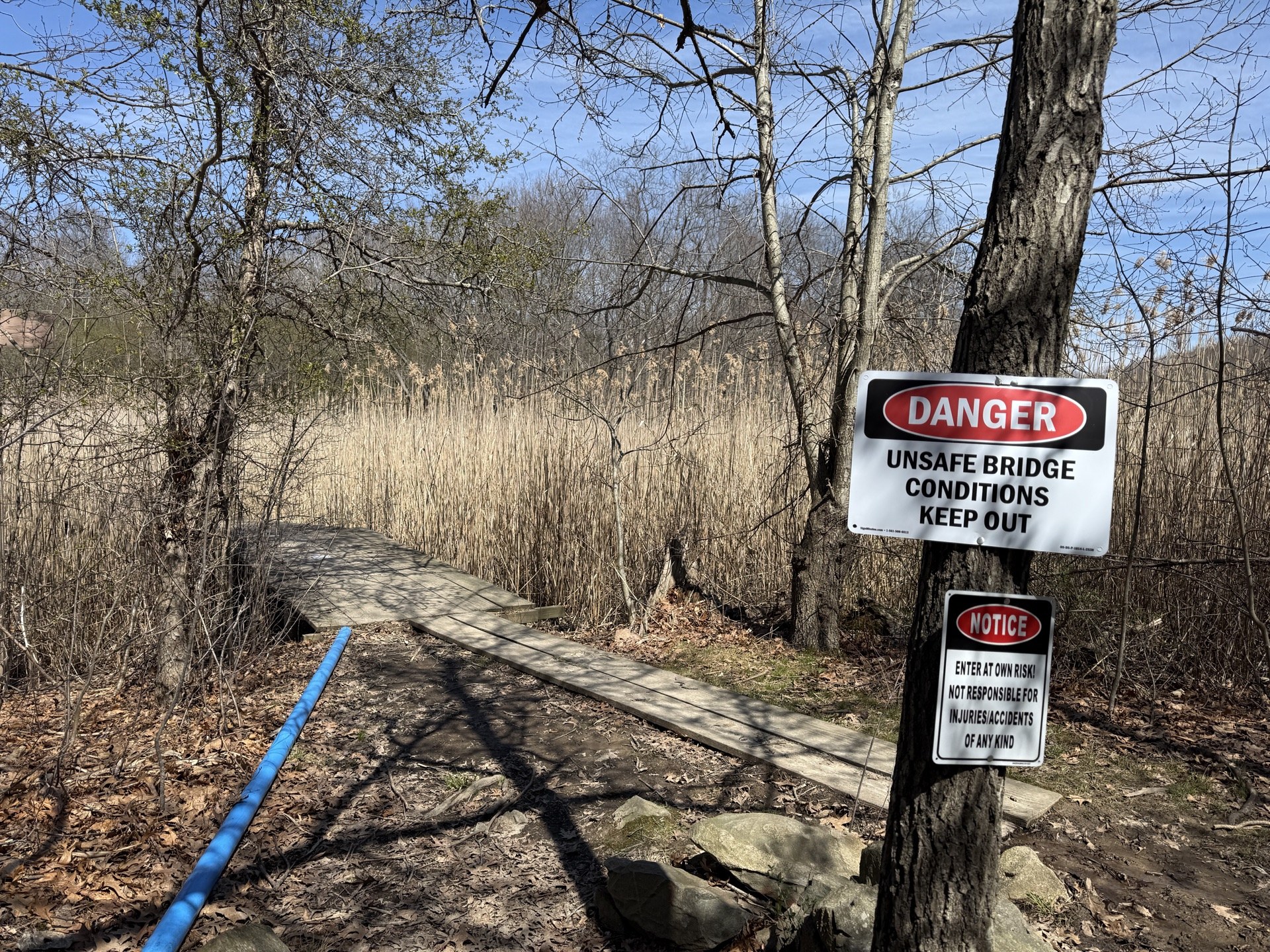
Walking the site, a resident observed what appears to be a roughly 20-foot length of 4-inch PVC pipe connecting that wetland to the adjacent bordering vegetated wetland. A connection like that does not appear in the delineation. If it is confirmed, the wetland is not isolated — and its boundary, its buffer, and the limits on what can be built near it would all change.
This is a question of fact, and it should be answered before any Order issues. We respectfully ask the Conservation Commission to direct the applicant’s wetland scientists to re-examine this connection on the record, and, if it is confirmed, to re-delineate the resource area accordingly. A classification this consequential should not rest on a connection that went unrecorded.
The current plan provides only 4 public spaces (3 regular + 1 ADA). At April 23 the developer offered on record to add one additional spot — bringing the total to 5 — against 683 parking spaces for project residents (524 in Phase I’s garage, 159 surface in Phase II). For a 140+ acre regional resource, five public spots is inadequate. Without 10 deeded public spaces, the Forest River and Salem Woods trails become a private amenity for the 485 new households.
The trail commitment is not the public’s wish list. It is the developer’s own proposal, in writing, in the section titled “Forest River Conservation Area Access.” What they offered to win the bid:
Why this matters: These trails sit on the developer’s own parcel, in the developer’s own approved plans. That puts them squarely within the Commission’s reach. “Build what you proposed” is the most defensible condition there is — it asks for nothing the developer did not already offer the Commonwealth in order to win this land.
Why ConCom holds the lever
The project’s Smart Growth subzone SZ-4 sits inside the 100-foot Wetlands Buffer. The existing parking lot sits inside the 25-foot No-Disturb Zone. The redevelopment cannot be built without work right up to the river bank. A No-Disturb Zone waiver is discretionary — and the conditions attached to it are the Commission’s lever.
Not a wish list. Each item is something the developer itself proposed to win this public land.
Build the trail network they proposed
The accessible footpaths and overlooks on the western and southern sides, plus the new path connection toward the Forest River and the re-established trailhead — all shown in their own RFP and Site Plan. Completed before the first certificate of occupancy.
Deliver the public art they said they would
Their proposal stated they would engage Salem’s art community and the Salem State University art department under Salem’s Public Art Master Plan. The Order should hold them to that stated intent.
Deeded public access
Public parking guaranteed at the Forest River trailhead via an easement recorded at closing, so people can actually reach the trails.
Stormwater & outfall mitigation
Compliance with all ten Massachusetts stormwater standards, confirmed by the City’s own reviewer and not just the developer’s engineer, plus erosion protection at the three outfalls and a performance bond. The baseline — but it belongs in the Order.
“The campus is going away — the access shouldn’t.”
How to Act— Now back the Commission —
Email the Conservation Commission, email DCAMM, and share this with neighbors. Below: rebuttals to the developer’s expected claims, both pre-written emails, the hearing calendar, and a procedural note.
Defensible answers every supporter can use — in your emails, in the Zoom chat, in conversation.
They say →
“We’re already contributing — five public parking spaces, trailhead improvements, invasive species removal, interior park and courtyard amenities for the community.”
You say →
None of those are negotiated public concessions. Invasive removal and stormwater compliance are the baseline any developer owes in a wetlands-adjacent 40R project — the City’s peer review already flagged outfall erosion and stormwater gaps that require remediation regardless of what’s “offered.” The interior “park” and courtyard areas are resident amenities — they serve the new neighborhood, not the city. And the trailhead improvements are a bike rack and landscaping at the doorway — not the accessible footpath network with overlooks the developer’s own proposal promised to build through the woods. The five parking spaces sit against the developer’s own filings: 683 parking spaces for project residents — more than 135 residents’ spaces for every 1 public spot.
Peer 40R cities show what conditions look like: Easton required $1.5M in developer-funded off-site improvements; Grafton secured 14.15 acres permanently deeded under Article 97. ConCom’s authority on this project is specific and discretionary — the No-Disturb waiver can be conditioned on mitigation reasonably related to the impact.
They say →
“The trails on the western and southern sides just aren’t feasible.”
You say →
They were feasible enough to put in the proposal that won you the land. Your own Site Plan draws those trails: the switchback paths labeled “OVERLOOKS + TRAILS” climb that exact slope, and your proposal sold the same hill as a feature — the design “nestles into the natural bowl created by the surrounding topography.” Switchbacks are the standard way to carry an accessible trail up a grade. The land hasn’t changed since you drew it. “Not feasible” here means “not willing to pay for it” now that the property is secured. Build what you proposed.
They say →
“We’re improving the trailhead — landscaping, a bike rack, trash removal.”
You say →
That is maintenance at the doorway, not access. Your proposal promised a “series of accessible footpaths” weaving through the woodland with overlooks on the western and southern sides. A bike rack is not that. The Order should require the trail network you actually proposed.
They say →
“The City’s 40R incentive funds can pay for trail improvements.”
You say →
40R state incentive funds exist to support schools, emergency services, and municipal capacity for new housing — not to subsidize what the developer offered to build to win the land. Under nexus and proportionality, you deliver your own commitment. The taxpayer is not your backstop.
They say →
“Our parking is sized for our residents, not the public.”
You say →
Exactly why deeded public parking is required. Your project doesn’t eliminate the public’s need for trail access — it multiplies it by adding nearly 1,000 residents to the same ecosystem. 10 deeded spaces is the minimum mitigation, not a favor.
They say →
“Building accessible trails on that grade needs costly engineering studies.”
You say →
You already designed them. Your proposal committed to trail resiliency “in concert with the Conservation Commission.” Set the scope with the City, as you offered to. The cost of the trails you promised is dwarfed by the cost of the project itself.
Both emails are already written for you and current as of the May 19 hearing. One asks the Conservation Commission to make the trails a binding condition on June 16. The other asks DCAMM — the state agency that sold this public land on the trail promise — why that promise was never locked in, and what it will do now. Each opens in your email app. Just add your name and address at the bottom before you send.
⚠ Important: add your Name & Address at the bottom of each email!
Conservation Commission
Initial hearing opened
April 21
Completed
Salem Planning Board
Phase I approved · Phase II continued
April 23
Completed
Conservation Commission
Bait-and-switch on trails · continued to June 16
May 19
Continued
Conservation Commission
Order of Conditions · resumes
June 16
6:30 PM
Click “Salem Conservation Commission SharePoint website” for the full files.
Procedural Note
The strength of any public hearing rests on procedural fairness. Massachusetts conflict-of-interest law — MGL Chapter 268A, §23(b)(3) — requires municipal officials to file a written disclosure whenever a relationship with an applicant or their representatives could reasonably be perceived to affect their judgment. It is a routine safeguard that protects public trust in every city decision.
Residents attending the June 16 hearing may respectfully ask the Conservation Commission, as a matter of ordinary procedure, to confirm that all required disclosures are on file for the matters being heard. It is a fair question. It assumes good faith. The answer — either way — belongs in the public record.